 Innotex Group


Why Choose PS Sheet Roll for Your Business?
Choosing the right material can affect production speed, product appearance, and day-to-day costs. Ps Sheet Roll is used in applications such as thermoformed trays, protective packaging, and display components. Its smooth surface and consistent thickness can support clean forming and a neat finish. Still, results depend on the grade, sheet design, and equipment settings.
A practical evaluation starts with the actual product. Check thickness, width, forming behavior, and how the material handles during cutting and storage. Ask suppliers for technical specifications, then test samples on your own line. Small details matter. A roll that performs well in one process may not suit another, especially when heat, shape, or load requirements change.
Cost deserves a closer look, too. Compare usable output and processing needs, not just the price per roll. Also consider packaging, storage space, and material waste. The choice is not automatic. Ps Sheet Roll may offer a useful balance of processability and presentation, but it is not ideal for every application. Careful trials and clear supplier information help businesses make a decision they can verify, rather than relying on claims alone.
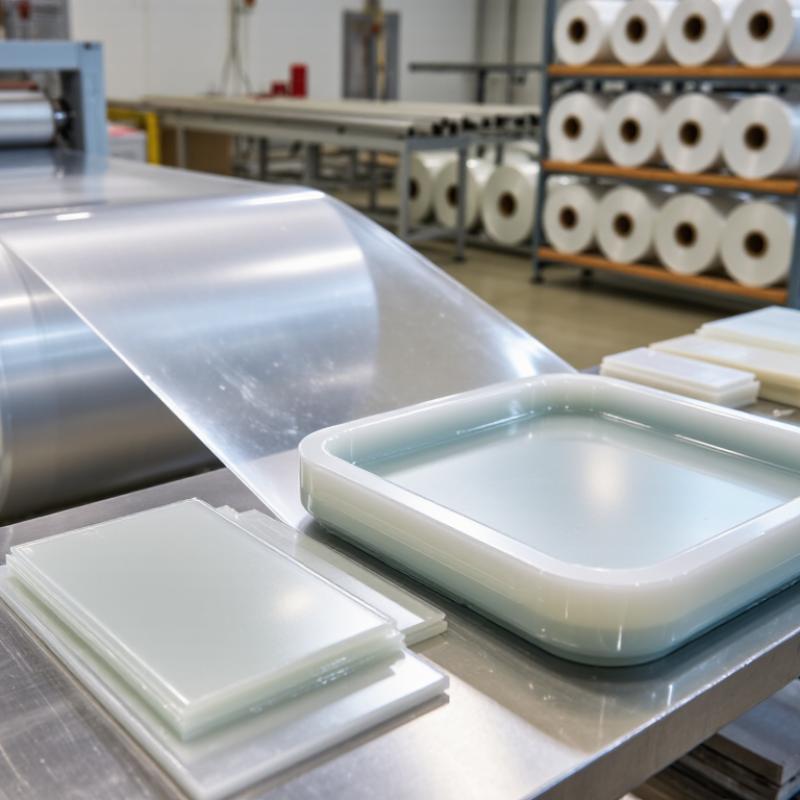
What PS Sheet Roll Is and How It Is Produced
PS sheet roll is a continuous, flexible-length sheet made from polystyrene resin. It is commonly supplied in general-purpose or impact-modified grades. General-purpose polystyrene is typically clear and stiff; impact-modified grades are less brittle. Both can be shaped into items such as display parts and thermoformed packaging. The right grade depends on the forming method and the finished part’s strength needs.
Production begins by melting polystyrene pellets and pushing the melt through a flat extrusion die. The sheet then passes over cooled rolls, which help set its thickness and surface. It is wound into rolls after cooling and inspection. The process is controlled. Operators check thickness, edge quality, and winding tension, since small variations can cause trouble during later forming. Plastics Europe’s Plastics – the Fast Facts 2023 report estimates global plastics production at 400.3 million tonnes in 2022. That figure covers all plastics, not polystyrene alone. It provides scale, but should not be mistaken for PS demand. Buyers should confirm grade, roll width, thickness tolerance, and forming temperature with their supplier. PS is rigid and easy to process, yet can crack under impact; the trade-off deserves a practical trial.
| Topic | What It Means | Business Relevance |
|---|---|---|
| Material definition | PS sheet is a flat plastic sheet made from polystyrene. A sheet roll is sheet supplied wound on a core rather than as individual flat panels. | Roll supply can suit continuous feeding and automated converting equipment, when the sheet’s thickness and stiffness allow it to be wound. |
| Common PS grades | GPPS (general-purpose polystyrene) is typically clear and rigid. HIPS (high-impact polystyrene) contains a rubber modifier and is generally tougher and more impact-resistant, but usually less transparent. | Choose the grade according to appearance, stiffness, impact needs, and the forming process. Properties vary by formulation and supplier specification. |
| Raw material preparation | Polystyrene resin pellets are fed into an extrusion line. Colorants or other additives may be incorporated when required by the product specification. | Confirm resin grade, color, and any required food-contact or regulatory documentation for the intended end use. |
| Melting and extrusion | A heated extruder melts and mixes the resin, then pushes the melt through a flat sheet die to create a continuous web. | The process supports continuous production. Sheet width and thickness should be matched to the converting equipment and finished-part design. |
| Cooling and thickness control | The hot sheet passes through cooled rollers, which help cool, smooth, and control its thickness before it is trimmed. | Consistent thickness and a suitable surface finish help ensure reliable feeding and forming. Ask for the manufacturer’s tolerances. |
| Winding and inspection | After cooling and trimming, suitable sheet is wound onto a core. Producers may inspect dimensions, appearance, and winding quality before packing. | Check roll width, length, core size, winding direction, packaging, and handling requirements before ordering. |
| Typical converting uses | Depending on grade and specification, PS sheet can be used in thermoforming and other converting applications, including packaging and display components. | Confirm that the selected grade meets the product’s mechanical, visual, processing, and applicable compliance requirements. |
| Roll versus cut sheet | Rolls are suited to continuous lines and are easier to feed as a web. Thicker or more rigid PS sheet may be supplied flat because it is less suitable for winding. | Select the supply format based on line setup, storage space, material handling, and the sheet dimensions required. |
| Key purchasing checks | Specify grade, color or transparency, thickness, width, roll length, core dimensions, surface requirements, and permitted tolerances. | Request a technical data sheet and, where appropriate, a production sample to verify compatibility with your process and finished-product requirements. |