 Innotex Group


What Are the Top Types of PVC Sheets?
A Pvc Sheet can look like a simple flat panel, yet its formulation changes how it bends, resists impact, and handles heat or moisture. Rigid PVC sheets hold their shape in signs, equipment covers, and partitions. Flexible grades suit protective curtains and liners. Foam-core sheets are lighter, while clear and colored sheets serve different visibility and design needs. Small differences matter.
A useful editorial paraphrase of the materials-first approach in PVC technical author George Wypych’s work is: “Choose the sheet for its service conditions, not its appearance alone.” This is a paraphrase, not a verbatim quotation. Still, it captures a practical point: the right choice depends on the load, temperature, exposure, thickness, and fabrication method. A panel beside a sunny window may need different properties from one used indoors behind a machine guard.
This guide compares the main types of PVC sheets, their common uses, and the trade-offs buyers should check. It also considers surface finish, transparency, density, and processing needs. A product label rarely tells the whole story. Ask for a current technical data sheet, and confirm that its test conditions match your application. Not glamorous, but useful. Even careful selection has limits: actual service life depends on installation and exposure, and product claims deserve a closer look.
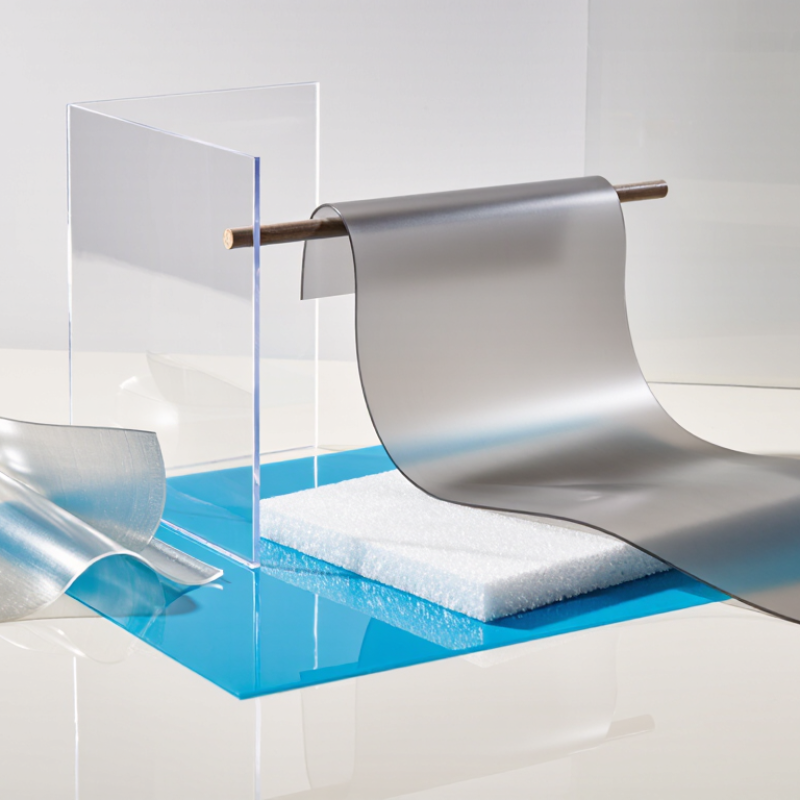
PVC Sheet Types at a Glance: ASTM D1784 Classifies Rigid PVC Compounds
The phrase “PVC sheet types” can mean rigid PVC, flexible PVC, or different rigid compound grades. ASTM D1784 covers rigid PVC and CPVC compounds. It classifies material performance, not sheet thickness, color, or format. Its cell-class system groups compounds by defined property ranges, including impact and tensile performance. A grade number is useful only alongside test data and the sheet’s service conditions. Not a shape label.
That distinction matters on the shop floor. A machine guard may need impact resistance; a loaded panel may need stiffness and dimensional stability. A drilled edge can expose weaknesses that a flat sample hides. ASTM International’s D1784 specification provides a basis for comparing rigid compounds. PlasticsEurope’s Plastics—The Fast Facts 2023 reports global plastics production of 400.3 million tonnes in 2022, with PVC accounting for about 12.4%. That market share shows PVC’s scale, not a sheet’s suitability. Ask for the exact ASTM cell classification, test methods, and temperature limits. One caveat: published compound values may not predict a machined part perfectly.
What Are the Top Types of PVC Sheets? — PVC Sheet Types at a Glance: ASTM D1784 Classifies Rigid PVC Compounds
| PVC Sheet Type | Structure or Formulation | Typical Characteristics | Common Uses | ASTM D1784 Context |
|---|---|---|---|---|
| Rigid PVC (PVC-U) sheet | Unplasticized, solid polyvinyl chloride | Rigid, corrosion-resistant, and electrically insulating; available in opaque and translucent grades. | Fabricated tanks, ductwork, protective panels, and machine guards. | Rigid PVC compounds may be classified under ASTM D1784. The applicable classification depends on the compound’s tested properties. |
| Impact-modified rigid PVC sheet | Rigid PVC compound formulated with impact modifiers | Designed to improve impact performance compared with a corresponding unmodified formulation; actual performance varies by grade and thickness. | Equipment enclosures, formed components, and applications where handling or service impact is a concern. | Impact performance is one of the properties addressed by the standard’s compound classification system; verify the supplier’s test data for the specific grade. |
| Transparent rigid PVC sheet | Solid rigid PVC formulated for optical clarity | Allows visibility through the sheet; clarity, color, and weathering performance depend on formulation and processing. | Viewing panels, covers, guards, and fabrication prototypes. | Transparency is not, by itself, an ASTM D1784 classification. The underlying compound may be assessed against the standard’s applicable requirements. |
| Foam PVC sheet | Cellular PVC with a foamed core; some products have denser outer surfaces | Lower density than solid PVC sheet and relatively easy to cut and machine; properties differ from solid sheet. | Signage, display structures, interior panels, and lightweight fabricated parts. | Do not assume a cellular sheet is classified in the same way as a solid rigid compound. Check the product specification and the test method’s scope. |
| CPVC sheet | Chlorinated polyvinyl chloride compound | Offers higher temperature capability than standard PVC in suitable grades; allowable service conditions depend on the product and application. | Chemical-processing equipment and components exposed to elevated temperatures, where the grade is specified for the service. | ASTM D1784 covers rigid PVC and CPVC compounds. Confirm the specific compound classification and application requirements. |
Note: ASTM D1784 classifies rigid PVC and CPVC compounds by specified property requirements; it does not define sheet dimensions, colors, or fabrication methods. A sheet’s suitability should be confirmed using the manufacturer’s technical data and the requirements of its intended application.