China Best Thermal Sticker Labels Manufacturer for Global Buyers?
Choosing a China-based supplier for Thermal Sticker Labels is not just a price comparison. It is a check on whether the label will print clearly, stick reliably, and arrive consistently. A roll can look perfect under showroom lights, then curl on a cold carton or leave residue on a reusable container. Small details matter.
Mike Fairley, a veteran label-industry analyst, offers a useful principle here, paraphrased rather than presented as a verbatim quotation: “A label performs well only when its material, adhesive, and printing process are matched to the real application.” That is a practical test for global buyers. Ask suppliers to explain the facestock, adhesive type, roll dimensions, and printer compatibility. Request samples, then test them on your own packaging and equipment. A clean sample is a start, not proof.
This guide examines how buyers can assess Chinese manufacturers beyond catalog claims. It looks at direct thermal and thermal-transfer options, print clarity, adhesive behavior, production consistency, and export support. Check whether specifications are documented and whether sample results match production batches. Also ask how the supplier handles changes in artwork or order volume. Not every buyer needs the same label. That sounds obvious, yet it is often missed. A careful comparison may take longer, but it can prevent costly relabeling, delayed shipments, and wasted stock.
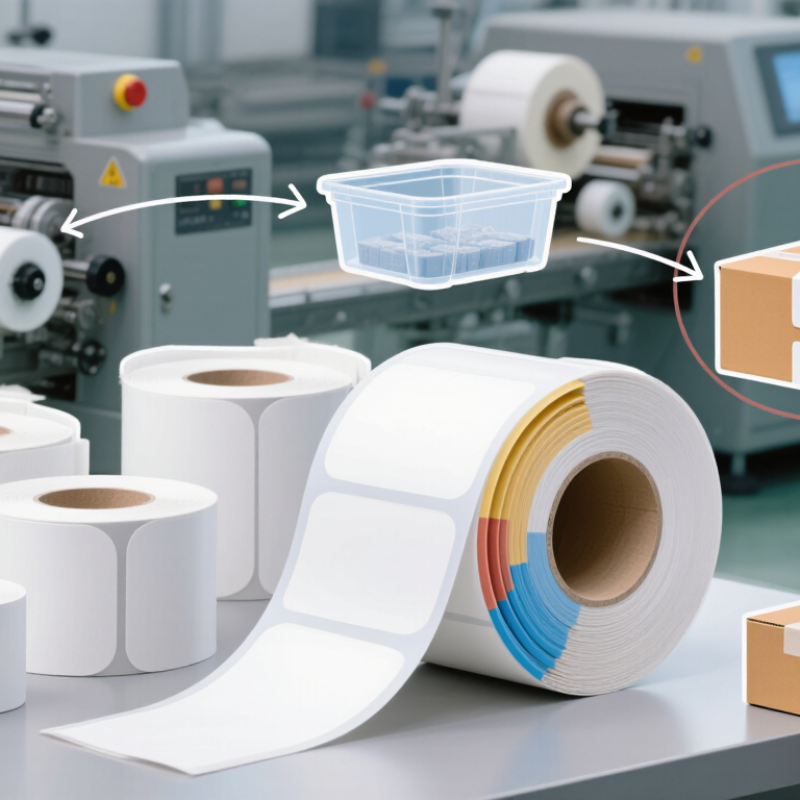
What Thermal Sticker Labels Are and How They Work
Thermal sticker labels use a heat-sensitive coating to create text, numbers, or barcodes. In direct thermal printing, a printhead heats tiny points on the label surface. Those points darken and form the image. No ink is needed. The process is clean and simple, but the printed surface can fade when exposed to heat, sunlight, or friction.
A typical label has three parts: a printable face, an adhesive layer, and a backing liner. The face passes under the printer’s heated printhead, while the liner helps the label feed smoothly. Pressure and temperature settings matter. Too little heat can produce pale barcodes; too much may darken the background or shorten printhead life. Small details count.
Thermal transfer printing works differently. It uses a heated ribbon to transfer ink onto the label, often giving the image greater resistance to wear. That distinction matters when labels must remain readable for longer periods. For short-term shipping or shelf labels, direct thermal stock may be practical. Still, performance depends on the coating, adhesive, printer settings, and storage conditions. A label left beside a warm window may not age as expected, even if it looked crisp at printing.
How Thermal Sticker Labels Are Designed and Manufactured
Thermal sticker labels start with the job they must perform. A shipping label needs sharp barcodes and dependable adhesion on corrugated cartons. A chilled-food label faces moisture and temperature changes. These conditions guide the choice of facestock, adhesive, and thermal coating. Direct thermal labels react to heat without a ribbon; thermal-transfer labels use a ribbon for image formation. The right choice depends on print life, handling, and exposure.
Design becomes manufacturing through controlled coating, drying, slitting, and die-cutting. The coating must respond evenly to the printer head, while the adhesive must bond without excessive residue. Converters check roll width, core size, edge quality, print darkness, and barcode readability. Small variations matter. A label that feeds poorly can interrupt an entire packing line.
Grand View Research valued the global labels market at USD 45.5 billion in 2022 and projected a 4.8% compound annual growth rate from 2023 to 2030. This covers labels broadly, not thermal labels alone, but it reflects growing demand for dependable identification across industries. Testing should match the real application, not just a lab surface. That step is easy to underestimate. A technically sound label can still disappoint if storage conditions or printer settings are overlooked.
Which Materials and Printing Methods Shape Label Performance
Thermal sticker performance starts with the face material, not the printer alone. Coated paper is economical and prints dark, crisp text, but moisture and rubbing can shorten its useful life. Polypropylene resists splashes and tearing, while polyester handles more demanding heat and abrasion. Each option has a trade-off. Small details matter.
Direct thermal printing uses a heat-sensitive coating and needs no ribbon, making it practical for short-lived shipping or shelf labels. Heat, sunlight, and friction can darken or fade the image sooner than expected. Thermal transfer printing adds a ribbon, often improving durability on synthetic films. Match ribbon chemistry to the face stock; a mismatch can cause pale bars or smudging. Test before scaling.
Adhesive choice matters just as much. A label applied to cold, dusty corrugated cartons may lift at the corners, even when the print looks excellent. Check initial tack, final bond, and removal needs on the actual surface. Then expose samples to expected temperatures, humidity, and handling. Results can be messy; one test rarely represents every route. I would avoid choosing from a data sheet alone.
How Global Buyers Can Evaluate Thermal Label Manufacturers
China Best Thermal Sticker Labels Manufacturer for Global Buyers?
How Global Buyers Can Evaluate Thermal Label Manufacturers
Choosing a thermal label manufacturer takes more than comparing prices. Start by matching the label to its real job: a shipping label, freezer tag, and retail shelf label may need different face materials and adhesives. Ask whether the product uses direct thermal or thermal transfer printing. The wrong match can cause fading, smudging, or poor adhesion. Small details matter.
Request samples made to your specifications, not just a standard sample pack. Print them using your own printer, then check barcode readability, edge lift, and print clarity. Test labels on the actual cartons, containers, or packaging surfaces. If they will face heat, moisture, or long storage, include those conditions in your checks. Test before scaling.
Also review how the manufacturer controls production. Ask about incoming material checks, batch identification, inspection records, and how defects are handled. A neat sample can still hide an inconsistent production process. Request realistic lead times and confirm how changes to size, roll direction, or core dimensions are approved. Clear answers are useful evidence; vague promises are not. No checklist catches everything, and a small trial order may still reveal problems that samples cannot.
Where Thermal Sticker Labels Are Used Across Industries
Thermal sticker labels support fast identification across retail, logistics, food packaging, and manufacturing. In a busy shop, they show prices and product codes on shelves or packages. Warehouse teams use them for carton labels, location tags, and shipment routing. The print can be produced quickly, which helps when stock changes often. Small details matter.
In food distribution, labels can carry batch dates and handling information on chilled containers. Cold rooms expose weaknesses. Adhesive performance may change on damp or frosty surfaces, so testing the actual packaging is important. Manufacturers also use labels to track parts through assembly and inspection. For patient samples or supplies, clear, readable identification helps staff distinguish items, but label materials should suit the specific storage conditions.
Buyers should consider the printer type, label surface, adhesive, and expected exposure before choosing a roll. Direct thermal labels suit many short-term uses, while thermal transfer printing can offer better resistance when matched with the right ribbon and stock. Neither option fits every job. A label that works on a dry cardboard carton may lift from a curved plastic tub. Test samples in real conditions, including handling and temperature changes, before ordering at scale.
 Innotex Group