 Innotex Group



2026 Top Chocolate Wrapping Machinery for Global Buyers
Chocolate wrapping decisions are made at the line, not just in a brochure. A praline’s corners can catch on a film fold. A glossy bar can lose its clean presentation when seals vary. For global buyers comparing Chocolate Wrapping Machinery in 2026, those small details matter as much as rated speed.
Packaging technology author Walter Soroka offers a useful framework for evaluating the job: packaging should protect a product through handling, storage, and distribution. Adapted for chocolate buyers, the principle is simple: “A wrapper must protect the chocolate and present it consistently at production speed.” This is an editorial adaptation, not a verified direct quotation from Soroka. Buyers should still check machine trials and supplier documentation.
Look closely at format flexibility, film compatibility, changeover time, sealing quality, and operator access. Ask for sample runs using the actual product and wrapping material. Watch how the machine handles delicate pieces, not only ideal test samples. Check whether cleaning and routine adjustments are practical for the plant’s team.
Fast is not always better. A machine that runs steadily may outperform one with a higher headline speed but frequent stoppages. There is a trade-off. Even careful testing cannot predict every production shift, so leave room for follow-up checks after installation. This guide compares key machine types and buyer considerations, while recognizing that the best choice depends on product shape, output targets, and available service support.
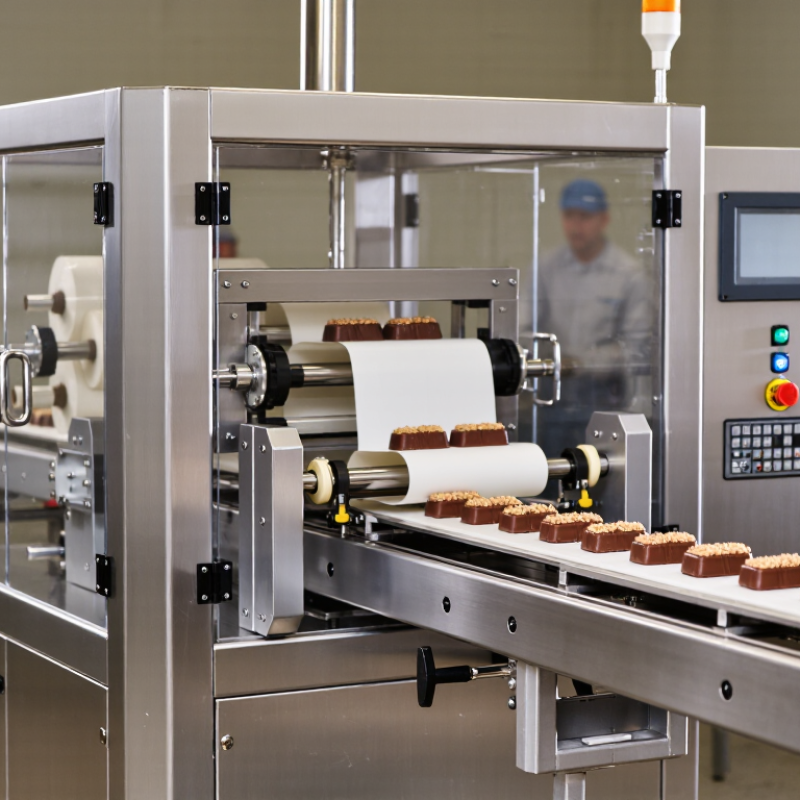
What Chocolate Wrapping Machinery Does in the Production Process
Chocolate wrapping machinery connects cooling and tempering with storage and shipment. After a bar leaves the cooling tunnel, an infeed conveyor spaces and aligns it for wrapping. Sensors detect gaps or tilted pieces. The machine then folds or seals the chosen film around each chocolate, often adding a date or batch code. Small details matter: uneven spacing can cause jams, while excess heat near the sealing jaws may soften delicate coatings.
Wrapping protects chocolate from moisture, odors, scuffs, and handling. Depending on product shape and shelf-life needs, manufacturers may use flow wrapping, fold wrapping, or twist wrapping. Operators check seal strength, print legibility, and package alignment during production—not only at the end. A wrapper cannot correct poorly tempered chocolate. That part is easy to overlook.
The wider equipment market shows why this stage receives investment. Grand View Research valued the global food packaging equipment market at about USD 21.7 billion in 2023 and projected a 5.2% compound annual growth rate from 2024 to 2030. This covers many food categories, not chocolate alone, but signals continued demand for packaging capacity and automation. For buyers, actual output depends on bar dimensions, wrapper changeover time, film behavior, and planned line speed. A faster machine is not always a better fit. Trials with the intended product and packaging material can reveal problems that a specification sheet misses.
2026 Top Chocolate Wrapping Machinery for Global Buyers - What Chocolate Wrapping Machinery Does in the Production Process
| Production Stage | Machinery Type | What It Does | Common Packaging or Product Format | Key Integration and Selection Considerations |
|---|---|---|---|---|
| Product infeed and distribution | Chocolate feeder, conveyor, or product aligner | Transfers finished chocolates to the wrapping line and spaces or orients them for consistent feeding into the wrapping machine. | Individual bars, tablets, pralines, or other finished pieces, depending on the line configuration. | Match the infeed system to product dimensions, shape, surface sensitivity, and the required feed orientation. Gentle handling helps reduce scuffing and breakage. |
| Primary wrapping | Flow wrapping machine | Forms a package from a flexible film roll, wraps the product, and seals the film at the back and ends. | Chocolate bars, snack bars, and other regularly shaped individual products. | Check product dimensions, film compatibility, seal requirements, cutting method, and available line space. Sealing performance depends on the packaging material and operating conditions. |
| Primary wrapping | Fold wrapping machine | Folds a pre-cut sheet or web around a chocolate piece to create a close-fitting wrap. | Tablets, blocks, and selected shaped chocolates using suitable wrapping materials. | Confirm that the machine supports the product shape and chosen material. Fold quality depends on accurate product positioning and consistent material feeding. |
| Primary wrapping | Twist wrapping machine | Wraps a piece in a cut sheet and twists or secures the ends, according to the machine and material configuration. | Individually wrapped pieces, including some candies and chocolate confectionery. | Verify product shape, wrapper dimensions, material behavior, and the required end finish. Not every chocolate shape or wrapper material is suitable for twist wrapping. |
| Primary wrapping | Pre-made pouch or sachet packaging machine | Opens and fills pre-made packs, then closes them using the specified sealing method. | Chocolate pieces, small assortments, or other products suited to pouch-style packs. | Assess pouch dimensions, opening and filling behavior, product count or target weight, and seal requirements. Product feeding may require a separate dosing or counting system. |
| Secondary packaging | Cartoning machine | Forms or loads cartons and places wrapped products or product groups into them before closing the carton. | Wrapped bars, multipacks, boxed assortments, and other retail packs. | Coordinate carton dimensions, product collation, carton style, and upstream supply. Cartoning equipment generally handles secondary packaging rather than wrapping each chocolate piece. |
| End-of-line packing | Case packer | Groups finished packs and loads them into shipping cases for distribution. | Cartons, multipacks, or other sale-ready packages. | Confirm case size, pack pattern, case-erecting and closing needs, and connection to downstream handling or palletizing equipment. |
| In-line quality control | Checkweigher | Weighs packs moving along the line and identifies products outside configured weight limits. | Individual packs, cartons, or other units supported by the installed system. | Choose a system suited to the product and pack range, line layout, and inspection requirements. A checkweigher measures weight; it does not replace correct filling or dosing. |
| In-line foreign-body inspection | Metal detector or X-ray inspection system | Inspects products or packs for specified foreign-body risks using the detection technology selected for the application. | Unwrapped products or packaged products, depending on the system and packaging materials. | Inspection suitability depends on the product, package construction, target contaminants, and validation requirements. Select and position equipment as part of the site’s food-safety control plan. |
| Line control and changeover | Conveyors, sensors, and line controls | Connect equipment, regulate product transfer, and coordinate machine operation or accumulation across the packaging line. | Transfers between feeding, wrapping, inspection, cartoning, and case packing stages. | Review product flow, accumulation capacity, guarding, cleaning access, changeover procedures, and compatibility between machine controls. |